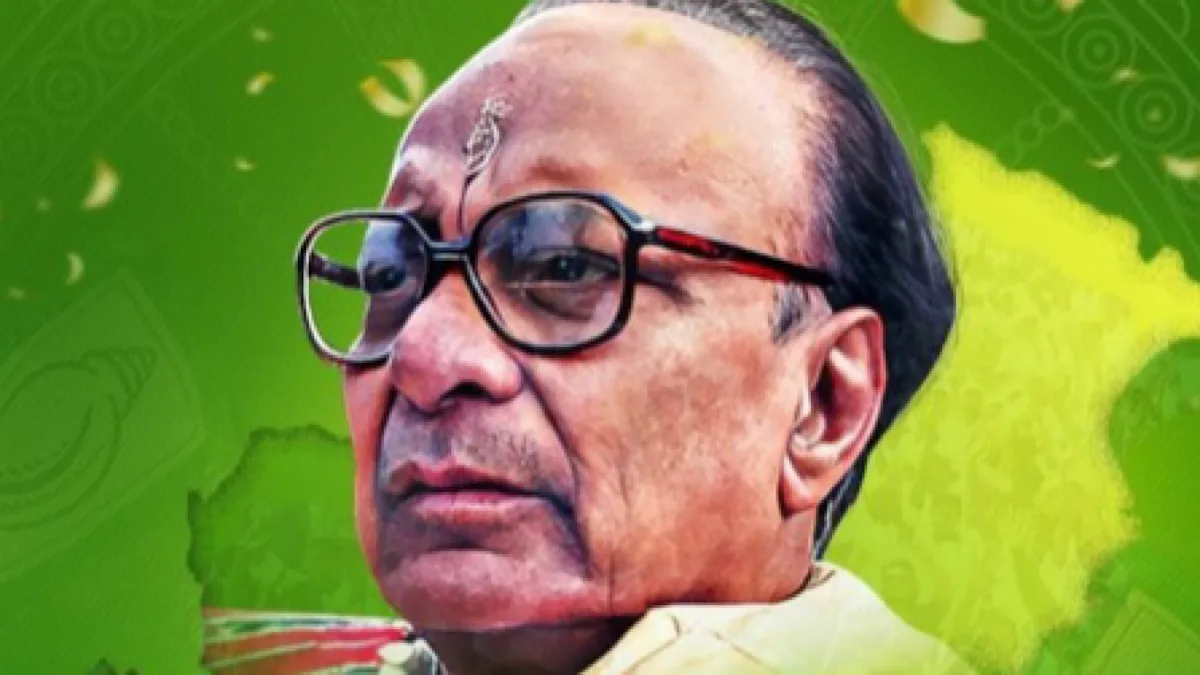
On his 29th death anniversary, a remembrance not of what he did — but of the audacious, irreverent, magnificent way he did it. In 1938, a young pilot from Cuttack decided to get married. The bride was Gyanwati Sethi of Rawalpindi — a Kinnaird College alumna from Lahore, no less — and the groom’s idea of a wedding procession was, naturally, to fly his entire baraat to Rawalpindi by aircraft.
No horses. No band. Just a squadron of friends descending from the skies onto the plains of Punjab. The bride herself held a commercial pilot’s licence — the first Indian woman to do so. Together, they would go on to dodge Dutch anti-aircraft fire over Indonesian skies, evacuate civilians from Japanese-occupied Burma, and raise three children, one of whom would govern Odisha for a quarter century, quite different from his father’s flair. That groom was Biju Patnaik. And the airborne baraat was, by his standards, a quiet Thursday. Twenty-nine years ago today, on 17 April 1997, Bijayananda Patnaik died in New Delhi.
Advertisement
He was eighty-one, a sitting Member of Parliament, and not the wealth creator that he was once. His coffin was draped in the flags of three nations — India, Russia, Indonesia. No Indian leader, before or since, has been claimed by three countries in death. The image is operatic, but Biju would have preferred the word “dramatic.” He was, after all, a man who idolised Napoleon. The Boy Who Cycled to Peshawar Before we get to the world wars, the rescued prime ministers, and the Pentagon briefings, consider the sixteen-year-old. In 1932, young Biju and two friends— Amar and Bhramarbar — climbed onto bicycles in Cuttack and pedalled 4,500 miles to Peshawar, on what they grandly called a “Visit India Mission.” No support vehicles. No sponsors.
Just three Odia boys on a quixotic journey across undivided India, spreading, as they put it, “the message of humanity.” Most teenagers collect stamps. Biju Patnaik collected horizons. He arrived at Ravenshaw College already too large for it. Captain of the football team. Captain of the hockey team. Captain of the cricket team. Captain of the athletics team. Science student. And then, abruptly, he quit. Because he had seen an aeroplane, and nothing else would do. He enrolled at the Delhi Flying Club, trained as a pilot, joined Indian National Airways, and never looked back at the ground.
Absconder’s Paradise His Delhi house during the freedom struggle earned a nickname that tells you everything: Absconder’s Paradise. Jayaprakash Narayan hid there. Ram Manohar Lohia passed through. Aruna Asaf Ali took shelter at his Anand Bhawan in Cuttack . Biju was simultaneously flying for the British as head of the Air Transport Command — and using every sortie to smuggle Congress leaders between safe houses, air-drop Quit India leaflets over Indian soldiers in Burma, and distribute Azad Hind Fauj pamphlets behind enemy lines. The British Intelligence Bureau compiled a long, exasperated dossier on him, eventually concluding that flying was his “normal way of making a living” and that even if they grounded him, the Tatas would hire him.
They arrested him anyway in January 1943. He spent nearly two years in prison, unbowed. What the British never quite grasped was that Biju Patnaik was not a man playing two sides. He was a man who simply refused to recognise the existence of sides. He would fly your planes, rescue your civilians, supply your allies — and simultaneously undermine your empire. The cognitive dissonance was entirely yours to manage. The Man Who Gave Indonesia Its President’s Name The Indonesia mission of July 1947 has been told often, but rarely with the detail it deserves. The Dutch had sealed all air and sea routes. Indonesian Prime Minister Sutan Sjahrir was under house arrest.
Nehru needed someone mad enough to fly a Dakota into hostile airspace with no refuelling options and no diplomatic cover. He needed Biju. Patnaik’s reply to the Dutch warning that he would be shot down was pure swagger: India did not recognise Dutch sovereignty over Indonesia, and if his plane went down, Dutch aircraft over India would follow. The Dutch fired. He dodged. He landed on an improvised strip near Jakarta, scooped up Sjahrir and Mohammad Hatta, refuelled from abandoned Japanese military dumps, and flew them to Delhi via Singapore. Indonesia’s independence followed. A grateful nation awarded him the Bhoomi Putra — Son of the Soil — one of its highest honours, an almost unheard-of distinction for a foreigner. But for the honour, he declined the other largesse offered to him in Indonesia. But here is the detail that turns history into fable: Biju and his wife Gyan grew close to President Sukarno’s family.
When Sukarno’s daughter was born, it was Biju Patnaik who suggested the name Meghavati — daughter of clouds. That child grew up to become Megawati Sukarnoputri, Indonesia’s first woman president. A man from Cuttack, in a sense, named the future leader of one of the world’s largest democracies. The clouds, one might say, remembered. Nehru’s Shadow Defence Minister This is perhaps the least explored chapter of Biju Patnaik’s life, and the most cinematic. During the 1962 India-China war, Nehru — shaken and desperate — turned to the one man he trusted with the nation’s military strategy who was not a general. While still serving as Chief Minister of Odisha, Biju was given an office next to Nehru’s own in Delhi and tasked with overseeing India’s defence effort.
His son Naveen, then about thirteen, later recalled his father’s fury at the Chinese incursion and his tireless work to repel it. In March 1963, Patnaik carried out a one-man covert mission to Washington. He held discussions at the Pentagon. He gave interviews to the Washington Post and the Baltimore Sun that caused a political storm back home. There are credible reports he visited CIA headquarters at Langley. He was India’s b uccane er- diplomat: to o important to ignore, too unpredictable to control, too effective to sideline.
An American journalist, Welles Hangen, included him in a book titled After Nehru, Who? — a question that tells you how seriously Washington took this pilot-turned- Chief-Minister from a state most Americans could not find on a map. He was among the frontrunners for Prime Minister in 1989, when Rajiv Gandhi’s Congress fell. But Biju Patnaik stepped back. V.P. Singh was chosen instead. Later, it was Biju who played kingmaker in installing H.D. Deve Gowda as PM. The throne was always within reach; he preferred the cockpit. The Industrialist Who Gave It All Away Here is the great inversion of Indian public life. Politicians enter poor and leave rich.
Biju Patnaik entered rich and left with nothing. In the 1950s, he built an industrial empire that would have been the envy of any Bombay magnate. Kalinga Tubes — Asia ‘ slargest pipe-manufacturing plant. Kalinga Airlines — whose pilots later became the heads of Air India and Indian Airlines. The first refrigerator factory in Odisha. Textile mills. Iron works. Manganese mines. Iron ore from Malangtoli, the finest grade in the world. A daily newspaper. All bearing the name Kalinga — his private salute to Odisha’s ancient glory. But politics consumed his wealth like a furnace.
He poured money into causes, institutions, and visions. At thirty-five, he funded the Kalinga Prize for the Popularisation of Science and handed it to UNESCO. It became the world’s most prestigious science communication award after the Nobel. He lured J.B.S. Haldane — one of the greatest biologists of the twentieth century — to Bhubaneswar when the rest of India’s bureaucracy had driven the man to despair. He built Paradip Port with state funds when Delhi dithered, then watched the Centre take it over. He set up IDCOL, OMC, airstrips across Odisha, engineering colleges, agricultural universities.
He spent himself bankrupt in the service of a state that, at the time, barely registered on India’s political map. The Maverick’s Creed Biju Patnaik rode a bicycle to the State Secretariat. He danced at Navy Balls. He told off bureaucrats in language that would make a sailor blush. He spoke to college students about population control with a candour no politician today would dare: “I will give you a thousand jobs, but by the time I do, you stupid chaps will give birth to ten thousand kids.” He introduced 33 per cent reservation for women in panchayats — making Odisha the first state in India to do so — with a confidence born of observation, not ideology: mothers who ran households, he said, would run zilla parishads just as well. He advocated confiscation of assets for corrupt officials decades before anti-corruption became fashionable.
He demanded fiscal autonomy for states and full convertibility of the rupee when economists in Delhi thought these were lunatic ideas. And when he lost elections — which he did, spectacularly — he accepted the verdict and went home. No court cases. No sulking. No allegations of rigged machines. Democracy, to Biju, was a game. You played hard, you played fair, and when the whistle blew, you walked off the field. In 1963, he resigned as Chief Minister under the Kamaraj Plan — voluntarily giving up power to strengthen the party. Name one Indian politician today who would do the same. He once said: “I would like to die instantly — just fall down and die.” He did not get his wish.
But the words he left behind in 1992 remain the closest thing Odisha has to a founding scripture: “In my dream of the 21st century for the State, I would have young men and women who put the interest of the State before them. They will not be at anybody’s mercy, except their own selves. By their brains, intelligence and capacity, they will recapture the history of Kalinga.” India’s political class today is a carefully curated spectacle of caution, calculation, and hesitation.
Biju Patnaik was none of these things. He was reckless where others were prudent. Generous where others hoarded. Blunt where others equivocated. Global where others were parochial. And yet, at the end, he belonged entirely to Odisha — a state he could have outgrown but chose instead to build. When they named a minor planet Kalinga in 1997, the year he died, it was fitting. Biju Patnaik always belonged to a slightly larger orbit than the rest of us. Superman did not wear a cape. He flew a Dakota, rode a bicycle, and told the truth. The author writes on Indian politics and history. Views are personal.